Across industries, enterprises are migrating away from legacy ETL and data warehouse platforms that have served them for a decade or more. SAS, Informatica PowerCenter, IBM DataStage, Microsoft SSIS, Alteryx, Teradata, Oracle Data Integrator, Talend, and Oracle PL/SQL-based pipelines — each of these platforms carries years of accumulated business logic, complex data flows, and deep organizational knowledge. The question is no longer whether to modernize, but where to modernize to.
Snowflake has emerged as the dominant migration target for legacy data workloads, and the reasons extend well beyond marketing. Snowflake's architecture fundamentally addresses the structural limitations that make legacy platforms expensive, fragile, and difficult to scale. This article examines why enterprises consistently converge on Snowflake, unpacking the architecture, the cost model, and the governance capabilities that make it the platform of choice for large-scale modernization. This is not a source-to-target migration guide — it is a strategic overview for architects and decision-makers evaluating Snowflake as a migration destination.
Snowflake Architecture: Three Layers That Change Everything
The foundation of Snowflake's advantage is its three-layer architecture, which separates storage, compute, and cloud services into independently scalable tiers. This separation is not merely a marketing diagram — it has concrete operational implications that directly address the pain points of legacy platforms.
Storage Layer
Snowflake stores all data in a proprietary columnar format within the cloud provider's object storage (S3 on AWS, Azure Blob Storage, or Google Cloud Storage). Data is automatically compressed, encrypted at rest, and organized into micro-partitions (small, immutable storage units of 50-500 MB compressed). There is no index management, no tablespace configuration, no vacuum operations, and no storage fragmentation. Organizations pay a flat rate per terabyte per month for storage, independent of compute usage.
For legacy data warehouse users accustomed to Oracle Exadata storage cells, Teradata BYNET storage, or SQL Server filegroups, the operational simplification is dramatic. There are no storage administrators to employ, no capacity planning exercises to conduct, and no data archival jobs to maintain. Snowflake's automatic micro-partitioning provides query pruning (skipping irrelevant partitions) without any DBA intervention, and clustering keys can be added declaratively for large tables with specific access patterns.
Compute Layer (Virtual Warehouses)
Virtual warehouses are independent compute clusters that execute queries against the shared storage layer. Each warehouse is a named resource with a configurable size (from XS to 6XL, each size doubling the compute capacity). Multiple warehouses can operate concurrently on the same data without contention, and each warehouse auto-suspends after a configurable idle period (as low as 60 seconds) and auto-resumes on the next query.
-- Create warehouses for different workloads
-- ETL warehouse: large for transformation workloads, suspends after 2 minutes
CREATE WAREHOUSE etl_wh
  WAREHOUSE_SIZE = 'LARGE'
  AUTO_SUSPEND = 120
  AUTO_RESUME = TRUE
  INITIALLY_SUSPENDED = TRUE;

-- Analytics warehouse: medium for BI queries, auto-scales for concurrency
CREATE WAREHOUSE analytics_wh
  WAREHOUSE_SIZE = 'MEDIUM'
  AUTO_SUSPEND = 300
  AUTO_RESUME = TRUE
  MIN_CLUSTER_COUNT = 1
  MAX_CLUSTER_COUNT = 4
  SCALING_POLICY = 'STANDARD';

-- Data science warehouse: large for Snowpark workloads
CREATE WAREHOUSE datascience_wh
  WAREHOUSE_SIZE = 'LARGE'
  AUTO_SUSPEND = 60
  AUTO_RESUME = TRUE;
This model replaces the fixed-capacity compute infrastructure of legacy platforms. Oracle RAC nodes, Teradata AMPs, DataStage parallel engine nodes, Informatica PowerCenter Integration Service processes, SSIS execution instances — all are fixed-capacity resources that require hardware procurement, OS patching, and capacity planning. Snowflake virtual warehouses resize in seconds with a single SQL command, and multi-cluster warehouses automatically add capacity when concurrent queries exceed the current cluster's throughput.
Cloud Services Layer
The cloud services layer handles authentication, access control, query optimization, metadata management, transaction coordination, and infrastructure management. This layer runs continuously and is included in Snowflake's pricing (it does not consume warehouse credits for most operations). It provides the "zero administration" experience that distinguishes Snowflake from legacy platforms.
The query optimizer in the cloud services layer automatically selects join strategies, determines partition pruning, manages result caching, and handles concurrency control. There are no optimizer statistics to gather (as in Oracle), no query plans to manually tune (as in Teradata), and no execution engine configuration to manage (as in DataStage or Informatica).
The three-layer architecture is the single most important factor in Snowflake's dominance as a migration target. It eliminates the fundamental constraint of legacy platforms: the coupling of storage, compute, and administration into a single, monolithic system that scales as a unit and fails as a unit. In Snowflake, each concern scales independently, fails independently, and costs independently.

Snowflake — enterprise migration powered by MigryX
Consumption-Based Pricing: The End of Fixed Licensing
Legacy ETL and data warehouse platforms use fixed-fee licensing models: annual licenses based on CPU cores (Oracle, Teradata), named users (SAS), IPU consumption units (Informatica IDMC), or server counts (SSIS, DataStage). These models share a common problem: you pay for peak capacity 24/7, even when workloads run for only a few hours per day.
Snowflake's consumption-based pricing fundamentally changes the cost equation. You pay for two things: storage (per TB per month) and compute (per credit per second of warehouse usage). Warehouses that are suspended consume zero credits. This means a batch ETL pipeline that runs for 2 hours per day costs compute for 2 hours, not 24. A data science workload that runs on weekday afternoons costs nothing on evenings and weekends.
Cost Comparison: Legacy ETL + Data Warehouse vs. Snowflake-Native
| Cost Category | Legacy ETL + Data Warehouse | Snowflake-Native |
|---|---|---|
| ETL software licensing | $500K – $5M+ annually (Informatica, DataStage, SAS) | $0 (transformations run as SQL/Snowpark on Snowflake) |
| Data warehouse licensing | $300K – $3M+ annually (Oracle, Teradata) | Consumption-based: typically $50K – $500K annually |
| ETL server infrastructure | $100K – $500K annually (VMs, networking, storage) | $0 (no ETL servers; compute is virtual warehouses) |
| DBA / ETL admin staff | 3 – 8 dedicated FTEs ($300K – $1.2M annually) | 0 – 1 dedicated FTE (platform is self-managing) |
| Scheduler licensing | $50K – $200K annually (Control-M, Autosys) | $0 (Snowflake Tasks are built-in) |
| Dev/Test environments | $100K – $500K annually (duplicate infrastructure) | Near $0 (zero-copy cloning, seconds to provision) |
| Disaster recovery | $200K – $1M annually (DR site, replication) | Built-in (replication, Time Travel, Fail-safe) |
| Annual license escalation | 5 – 15% increase per year | Pay-per-use (scales with actual workload growth) |
| Estimated Total (mid-size enterprise) | $1.5M – $10M+ annually | $200K – $1.5M annually |
The cost advantage of Snowflake-native processing compounds over time. Legacy platforms carry annual license escalation clauses (typically 5-15% per year), hardware refresh cycles every 3-5 years, and the hidden cost of maintaining specialized skills for declining technologies. Snowflake's consumption model scales linearly with actual workload growth, and the elimination of ETL middleware removes an entire cost category from the budget.
MigryX: Idiomatic Code, Not Line-by-Line Translation
The difference between MigryX and manual migration is not just speed — it is code quality. MigryX generates idiomatic, platform-optimized code that leverages native features of your target platform. A SAS DATA step does not become a clunky row-by-row loop — it becomes a clean, vectorized DataFrame operation. A PROC SQL query does not become a literal translation — it becomes an optimized query that takes advantage of your platform’s pushdown capabilities.
Snowpark: Multi-Language Compute on Snowflake
One of the most common objections to consolidating ETL on a data warehouse is the assumption that complex transformation logic requires an external runtime. Snowpark eliminates this objection by providing DataFrame APIs for Python, Java, and Scala that execute directly on Snowflake's compute engine. Snowpark code runs on virtual warehouses — the computation happens where the data lives, with no data movement to external processes.
# Snowpark Python: Complex transformation that would traditionally
# require an external ETL tool or Spark cluster
from snowflake.snowpark import Session, functions as F
from snowflake.snowpark.types import StringType

session = Session.builder.configs(connection_params).create()

# Read source data (no data leaves Snowflake)
transactions = session.table("bronze.raw_transactions")
customers = session.table("silver.dim_customers")
products = session.table("silver.dim_products")

# Complex transformation pipeline
enriched = (
    transactions
    .join(customers, transactions["customer_id"] == customers["customer_id"], "left")
    .join(products, transactions["product_id"] == products["product_id"], "left")
    .with_column("revenue", F.col("quantity") * F.col("unit_price"))
    .with_column("customer_segment",
        F.when(F.col("lifetime_value") > 100000, F.lit("Enterprise"))
         .when(F.col("lifetime_value") > 25000, F.lit("Mid-Market"))
         .otherwise(F.lit("SMB")))
    .with_column("product_margin",
        (F.col("unit_price") - F.col("cost_price")) / F.col("unit_price") * 100)
)

# Write results back to Snowflake (all computation happened on the warehouse)
enriched.write.mode("overwrite").save_as_table("gold.enriched_transactions")
Snowpark supports user-defined functions (UDFs) and user-defined table functions (UDTFs) in Python, Java, and Scala. These functions can be called from SQL, enabling a hybrid approach where complex logic is written in Python but invoked from SQL pipelines. This is particularly valuable for migrating SAS statistical procedures, custom Informatica Java transformations, or DataStage BuildOp stages that contain language-specific logic.
Dynamic Tables: Declarative Data Pipelines
Dynamic Tables represent Snowflake's most powerful simplification for legacy ETL migration. A Dynamic Table is defined as a SQL query, and Snowflake automatically maintains the result — keeping it fresh within a specified TARGET_LAG. There is no procedural code, no scheduling configuration, and no monitoring setup. Snowflake handles incremental refresh, dependency tracking, and failure recovery automatically.
-- A single Dynamic Table replaces:
-- 1. An ETL job (Informatica mapping, DataStage job, SSIS package, or Talend job)
-- 2. A scheduler configuration (TAC, Control-M, SQL Agent)
-- 3. A monitoring setup (alerts, retry logic, logging)

CREATE OR REPLACE DYNAMIC TABLE gold.customer_lifetime_value
  TARGET_LAG = '1 hour'
  WAREHOUSE = analytics_wh
AS
SELECT
    c.customer_id,
    c.customer_name,
    c.signup_date,
    c.region,
    COUNT(DISTINCT o.order_id) AS total_orders,
    SUM(o.amount) AS lifetime_revenue,
    AVG(o.amount) AS avg_order_value,
    MAX(o.order_date) AS last_order_date,
    DATEDIFF('day', MAX(o.order_date), CURRENT_DATE()) AS days_since_last_order,
    CASE
        WHEN SUM(o.amount) > 100000 THEN 'Platinum'
        WHEN SUM(o.amount) > 50000 THEN 'Gold'
        WHEN SUM(o.amount) > 10000 THEN 'Silver'
        ELSE 'Bronze'
    END AS calculated_tier
FROM silver.customers c
LEFT JOIN silver.orders o ON c.customer_id = o.customer_id
GROUP BY c.customer_id, c.customer_name, c.signup_date, c.region;
Dynamic Tables can be chained: a Dynamic Table can reference another Dynamic Table, creating a declarative pipeline graph that Snowflake manages end-to-end. This replaces entire ETL orchestration frameworks — Informatica workflows with multiple mapping tasks, DataStage job sequences, SSIS package chains, or Talend parent/child job hierarchies — with a set of SQL definitions that Snowflake refreshes in the correct dependency order.
Tasks and Streams: Native Orchestration and CDC
For ETL patterns that require procedural logic, conditional branching, or explicit scheduling, Snowflake Tasks and Streams provide native orchestration and change data capture.
Tasks support CRON-based scheduling and DAG-based dependency management (tasks can specify predecessors, forming execution graphs). Streams capture change data (inserts, updates, deletes) on tables, enabling incremental processing without custom CDC logic. The combination of Tasks and Streams replaces the scheduling and triggering capabilities of Control-M, Autosys, Informatica TAC, DataStage Sequencer, SSIS SQL Agent, Talend TAC, and Oracle DBMS_SCHEDULER.
-- Stream captures changes (inserts, updates, deletes) on source table
CREATE OR REPLACE STREAM silver.orders_stream
  ON TABLE silver.orders;

-- Task runs every 5 minutes, but only when new data exists
CREATE OR REPLACE TASK gold.incremental_order_summary
  WAREHOUSE = etl_wh
  SCHEDULE = 'USING CRON */5 * * * * UTC'
  WHEN SYSTEM$STREAM_HAS_DATA('silver.orders_stream')
AS
  MERGE INTO gold.order_summary t
  USING (
      SELECT
          DATE_TRUNC('day', order_date) AS order_day,
          region,
          SUM(amount) AS daily_revenue,
          COUNT(*) AS daily_count
      FROM silver.orders_stream
      WHERE METADATA$ACTION = 'INSERT'
      GROUP BY DATE_TRUNC('day', order_date), region
  ) s
  ON t.order_day = s.order_day AND t.region = s.region
  WHEN MATCHED THEN
      UPDATE SET t.daily_revenue = t.daily_revenue + s.daily_revenue,
                 t.daily_count = t.daily_count + s.daily_count
  WHEN NOT MATCHED THEN
      INSERT (order_day, region, daily_revenue, daily_count)
      VALUES (s.order_day, s.region, s.daily_revenue, s.daily_count);

ALTER TASK gold.incremental_order_summary RESUME;
Native Semi-Structured Data: VARIANT and FLATTEN
Legacy ETL platforms treat semi-structured data (JSON, XML, Avro, Parquet) as a special case requiring dedicated parsing components: Informatica's Hierarchy Parser, DataStage's XML Stage, SAS's LIBNAME JSON engine, SSIS's custom script tasks. Each requires configuration, schema mapping, and error handling that add complexity to pipeline design and maintenance.
Snowflake treats semi-structured data as a first-class citizen through the VARIANT data type. JSON, XML, Avro, Parquet, and ORC data can be loaded directly into VARIANT columns, queried with dot notation, and flattened with LATERAL FLATTEN — all in standard SQL. There is no external parser, no schema mapping configuration, and no separate handling for nested structures.
-- Load JSON data directly into a VARIANT column
CREATE OR REPLACE TABLE bronze.api_events (
    event_id STRING,
    received_at TIMESTAMP_NTZ DEFAULT CURRENT_TIMESTAMP(),
    payload VARIANT
);

-- Query nested JSON with dot notation and FLATTEN
SELECT
    payload:event_type::STRING AS event_type,
    payload:user:id::INTEGER AS user_id,
    payload:user:email::STRING AS user_email,
    f.value:product_id::STRING AS product_id,
    f.value:quantity::INTEGER AS quantity,
    f.value:price::NUMBER(10,2) AS unit_price
FROM bronze.api_events,
    LATERAL FLATTEN(input => payload:items) f
WHERE payload:event_type::STRING = 'purchase'
  AND received_at >= DATEADD('day', -1, CURRENT_TIMESTAMP());
Time Travel and Fail-Safe: Built-In Data Protection
Snowflake Time Travel provides access to historical data states for configurable retention periods (up to 90 days on Enterprise edition). This enables point-in-time recovery, audit queries, change analysis, and debugging — without any ETL-managed snapshot tables, backup jobs, or archival processes.
Fail-safe provides an additional 7 days of data protection beyond the Time Travel retention period, accessible only through Snowflake support for disaster recovery scenarios. Together, Time Travel and Fail-safe replace the backup infrastructure, snapshot jobs, and archival pipelines that legacy environments maintain at significant cost and complexity.
-- Query data as it existed 24 hours ago
SELECT * FROM silver.customers
AT(OFFSET => -86400);

-- Query data at a specific timestamp
SELECT * FROM silver.customers
AT(TIMESTAMP => '2026-04-07 10:30:00'::TIMESTAMP);

-- Restore a table to a previous state
CREATE OR REPLACE TABLE silver.customers
CLONE silver.customers AT(TIMESTAMP => '2026-04-07 10:30:00'::TIMESTAMP);

-- Zero-copy clone for development (instant, no storage cost)
CREATE DATABASE dev_analytics CLONE prod_analytics;
Governance: RBAC, Column Security, Row Access, and Data Masking
Enterprise migration decisions are increasingly driven by governance and compliance requirements. Snowflake provides a comprehensive governance framework that exceeds what most legacy ETL and data warehouse platforms offer natively.
| Governance Feature | Snowflake Capability | Legacy Platform Equivalent |
|---|---|---|
| Role-Based Access Control (RBAC) | Hierarchical roles with GRANT/REVOKE on all objects (databases, schemas, tables, columns, warehouses, tasks) | Varies: Oracle roles, Teradata access rights, platform-specific ACLs |
| Column-Level Security | Dynamic Data Masking policies applied to individual columns; different masking rules per role | Rarely native; typically requires ETL-based data redaction or view-based masking |
| Row-Level Security | Row Access Policies that filter rows based on the querying user's role or attributes | Oracle VPD, Teradata row-level security; most ETL platforms lack this entirely |
| Data Classification | Automatic and manual tag-based classification with SYSTEM$CLASSIFY; integrate with masking policies | Third-party tools (Collibra, Alation) or manual processes |
| Object Tagging | Tags on any object (database, schema, table, column) for governance, cost attribution, and policy enforcement | Limited or non-existent in legacy platforms |
| Access History | ACCESS_HISTORY view tracks who accessed what data, when, including column-level detail | Custom audit logging, often incomplete |
| Data Lineage | ACCESS_HISTORY includes read/write lineage; Snowflake Horizon provides visual lineage | Requires third-party tools or manual documentation |
| Network Policies | IP allowlisting, AWS PrivateLink, Azure Private Link, GCP Private Service Connect | Network-level controls, VPNs, firewall rules |
| Encryption | AES-256 encryption at rest and in transit; customer-managed keys (Tri-Secret Secure) | Varies by platform; often requires additional configuration |
| Data Retention / Time Travel | Configurable retention (1-90 days) + 7-day Fail-safe for compliance | Custom backup jobs and archival processes |
| Audit Logging | Comprehensive query history, login history, and object change tracking in Account Usage | Platform-specific audit logs, often siloed |
| Cross-Cloud Governance | Snowgrid: unified governance across AWS, Azure, and GCP deployments | Not applicable (legacy platforms are single-infrastructure) |
-- Dynamic Data Masking: PII columns masked for non-privileged roles
CREATE OR REPLACE MASKING POLICY pii_email_mask AS
(val STRING) RETURNS STRING ->
  CASE
    WHEN CURRENT_ROLE() IN ('DATA_ADMIN', 'COMPLIANCE') THEN val
    ELSE REGEXP_REPLACE(val, '.+@', '***@')
  END;

ALTER TABLE silver.customers MODIFY COLUMN email
  SET MASKING POLICY pii_email_mask;

-- Row Access Policy: Users see only their region's data
CREATE OR REPLACE ROW ACCESS POLICY region_filter AS
(region_col STRING) RETURNS BOOLEAN ->
  CURRENT_ROLE() = 'DATA_ADMIN'
  OR region_col = CURRENT_REGION_TAG();

ALTER TABLE silver.orders ADD ROW ACCESS POLICY region_filter ON (region);

-- Object Tags for governance and cost attribution
ALTER TABLE silver.customers SET TAG
  governance.data_classification = 'PII',
  governance.retention_policy = '7_YEARS',
  cost.business_unit = 'MARKETING';
Governance is often the deciding factor for enterprises in regulated industries. Financial services, healthcare, and government organizations require column-level masking, row-level security, comprehensive audit trails, and encryption with customer-managed keys. Snowflake provides all of these natively, whereas legacy platforms typically require third-party governance tools or custom-built solutions that add cost and complexity.
Data Sharing and Snowflake Marketplace
Snowflake Secure Data Sharing enables real-time data sharing between Snowflake accounts without data movement or copying. The data provider creates a share (a named collection of database objects), and the consumer creates a database from the share that appears as a read-only database in their account. The consumer queries the shared data using their own virtual warehouse, meaning the provider incurs zero compute cost for consumer queries.
This capability replaces an entire category of legacy ETL workloads: the data distribution pipelines that extract data from one system, transform it, and load it into another for consumption by different business units, partners, or subsidiaries. In legacy environments, these pipelines consume significant ETL resources and create stale data copies. Snowflake Secure Data Sharing provides live, governed access to the same data without any pipeline.
Snowflake Marketplace extends this concept to external data providers, offering curated datasets (weather, financial, demographic, geospatial) that can be queried directly without ingestion. This eliminates the ETL pipelines that organizations traditionally build to ingest and refresh third-party data feeds.
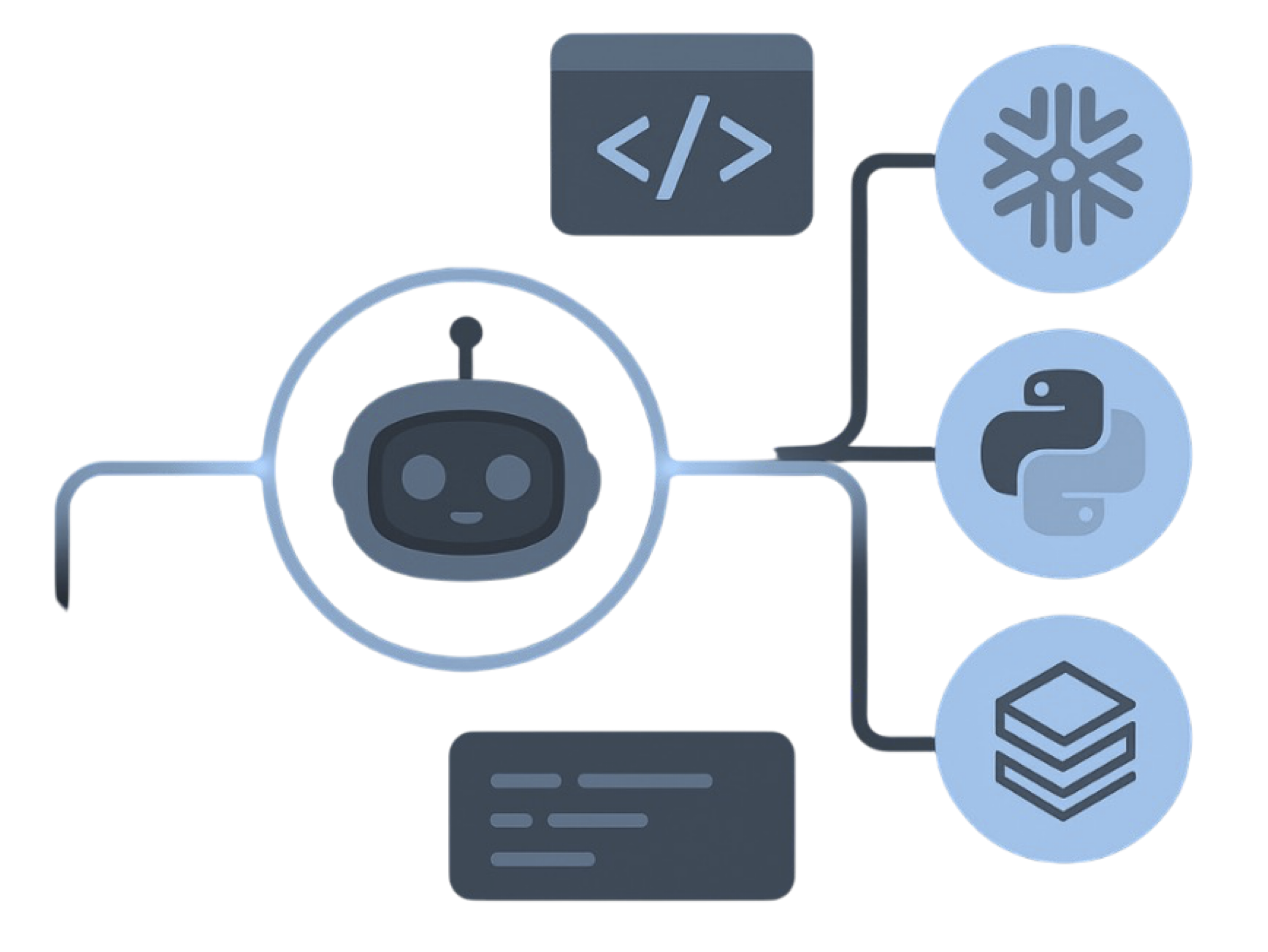
MigryX precision parser — Deep AST-level analysis ensures every construct is understood before conversion begins
Platform-Specific Optimization by MigryX
MigryX maintains deep knowledge of every target platform’s strengths and best practices. When converting to Snowflake, it leverages Snowpark and native SQL functions. When targeting Databricks, it uses PySpark DataFrame operations optimized for distributed execution. When generating dbt models, it follows dbt best practices for modularity and testability. This platform awareness is what makes MigryX output production-ready from day one.
Snowgrid: Cross-Cloud and Cross-Region Governance
Many enterprises operate across multiple cloud providers and regions due to regulatory requirements, business acquisitions, or multi-cloud strategy. Snowgrid provides a unified governance and data sharing layer across AWS, Azure, and Google Cloud deployments. Data can be replicated across regions and clouds with consistent RBAC policies, masking rules, and access controls.
Legacy platforms are typically bound to a single infrastructure deployment. Oracle Exadata runs on Oracle Cloud or on-premises. Teradata runs on Teradata infrastructure or Vantage on specific clouds. DataStage runs on IBM Cloud or on-premises Linux. Snowflake's cloud-agnostic architecture means a single governance framework spans all deployments, and data sharing works across clouds seamlessly.
Automatic Performance Optimization
One of the most time-consuming aspects of legacy data warehouse management is performance tuning. Oracle DBAs manage indexes, statistics, execution plans, and partitioning. Teradata DBAs tune primary indexes, secondary indexes, join indexes, and hash distribution. SQL Server DBAs manage clustered indexes, columnstore indexes, and query store. These activities consume significant DBA time and require deep platform expertise.
Snowflake eliminates nearly all manual performance tuning:
- No indexes — Snowflake's automatic micro-partitioning and partition pruning replace traditional B-tree and bitmap indexes. For large tables with specific access patterns, clustering keys provide additional optimization without index maintenance.
- No statistics gathering — Snowflake's optimizer continuously maintains metadata about data distribution, eliminating the need for manual ANALYZE or COMPUTE STATISTICS operations.
- No query plan pinning — The optimizer generates plans automatically based on current data distribution, without DBA intervention.
- Result caching — Repeated queries return cached results instantly (within 24 hours of the original query and before any data changes), without any caching configuration.
- Automatic scaling — Multi-cluster warehouses add capacity for concurrent workloads automatically, without DBA-managed connection pools or workload management rules.
Iceberg Tables: Open Format for Vendor Independence
Snowflake's support for Apache Iceberg Tables addresses a key enterprise concern: vendor lock-in. Iceberg Tables store data in the open Apache Iceberg format, meaning the data is accessible through any Iceberg-compatible engine (Spark, Trino, Flink, Dremio) even without Snowflake. This provides an exit strategy and interoperability layer that legacy proprietary formats (Teradata block format, Oracle data files, SAS datasets) never offered.
Iceberg Tables in Snowflake support the same SQL interface as native Snowflake tables, including DML operations, Time Travel, and access control. Organizations can use Iceberg Tables for data that needs to be shared with non-Snowflake compute engines (e.g., ML training on Spark) while maintaining Snowflake as the primary query and governance platform.
-- Create an Iceberg table with external storage
CREATE OR REPLACE ICEBERG TABLE bronze.sensor_readings
  CATALOG = 'SNOWFLAKE'
  EXTERNAL_VOLUME = 'data_lake_vol'
  BASE_LOCATION = 'sensor_data/'
AS
SELECT
    sensor_id,
    reading_timestamp,
    temperature,
    humidity,
    pressure
FROM staging.raw_sensor_data;
Migration Complexity Comparison by Source Platform
Not all legacy platforms present the same migration challenge. The following table compares migration complexity across major source platforms, considering transformation language proximity to SQL, availability of export formats, and the degree of platform-specific features that require rethinking.
| Source Platform | Overall Complexity | SQL Proximity | Platform-Specific Features | Typical Timeline (mid-size) |
|---|---|---|---|---|
| Teradata BTEQ/SQL | Low – Medium | High (SQL-based) | Primary index, QUALIFY, temporal tables | 3 – 6 months |
| Oracle PL/SQL | Medium – High | Medium (procedural SQL) | Packages, cursors, BULK COLLECT, triggers | 6 – 12 months |
| SSIS | Medium | Medium (SQL + .NET) | Data Flow tasks, Script tasks, SSIS variables | 4 – 8 months |
| Informatica PowerCenter | Medium | Low (visual mappings) | Mapping Designer, sessions, workflows, SQ overrides | 6 – 12 months |
| Informatica IDMC | Medium | Low (CDI mappings) | Secure Agents, taskflows, hierarchy parsers | 4 – 8 months |
| IBM DataStage | Medium – High | Low (parallel jobs) | Stages, BuildOps, job sequences, hashing | 6 – 12 months |
| Talend | Medium | Low (Java-generated) | tMap, tJavaRow, context variables, joblets | 4 – 8 months |
| SAS | High | Low (DATA Step + macros) | DATA Step, PROC SQL, macros, formats, ODS | 6 – 18 months |
| Alteryx | Low – Medium | Medium (SQL-translatable) | Spatial tools, predictive tools, macros | 3 – 6 months |
| Oracle ODI | Medium | Medium (SQL-based KMs) | Knowledge Modules, interfaces, topology | 4 – 8 months |
How MigryX Accelerates Snowflake Migration
MigryX is an enterprise platform purpose-built for automating the migration of legacy ETL and analytics workloads to modern platforms including Snowflake. The platform supports all major source platforms listed above and provides a structured, deterministic migration methodology.
MigryX Platform Capabilities
- AST-based deterministic parsing — MigryX parses source artifacts (SAS programs, Informatica XML, DataStage .dsx, SSIS .dtsx, Talend XML, PL/SQL DDL, Alteryx .yxmd, ODI exports, BTEQ scripts) using abstract syntax tree analysis. This is not regex matching or AI guessing — it is structural analysis that achieves +95% parser accuracy across all supported platforms.
- Column-level lineage — Every output column is traced back through transformations, joins, expressions, and source tables. Lineage documentation is essential for regulatory compliance (GDPR, CCPA, SOX) and for validating migration correctness.
- Multi-target output — Generate Snowflake SQL, Snowpark Python, stored procedures, Task DAG configurations, Dynamic Table definitions, and stage/pipe declarations. The platform recommends the optimal Snowflake pattern for each source artifact.
- STTM documentation — Source-to-Target Mapping documents generated automatically for every translated artifact, providing auditable documentation of every transformation rule, data type mapping, and behavioral change.
- Merlin AI — For complex patterns that require semantic understanding (business rule interpretation, platform-specific behavior differences, optimization recommendations), Merlin AI reviews the parsed AST and suggests Snowflake-native alternatives. AI suggestions are always validated against the deterministic parse result.
- On-premise / air-gapped deployment — The entire MigryX platform runs behind your firewall. Source code, data schemas, transformation logic, and lineage documentation never leave your infrastructure. This is a hard requirement for financial services, healthcare, government, and defense organizations.
- Complexity assessment and planning — Before any code conversion begins, MigryX inventories all source artifacts, classifies them by migration complexity, identifies dependencies, and generates a phased migration roadmap with effort estimates.
Decision Framework: When Snowflake Is the Right Target
While Snowflake is the leading target for most legacy migrations, the decision should align with your organization's specific workload profile and strategic direction. Snowflake is an excellent fit when:
- SQL is your primary transformation language — Snowflake's SQL dialect is comprehensive, with window functions, CTEs, MERGE, QUALIFY, FLATTEN, PIVOT/UNPIVOT, and procedural extensions (Snowflake Scripting).
- You want to eliminate ETL middleware — Snowflake's native capabilities (Snowpark, Dynamic Tables, Tasks, Streams) replace the core functions of Informatica, DataStage, SSIS, Talend, and other ETL tools.
- Cost predictability and optimization matter — Consumption pricing with auto-suspend eliminates idle-time costs and makes workload-level cost attribution possible through resource monitors and warehouse tagging.
- Governance is a priority — RBAC, column masking, row access policies, data classification, access history, and cross-cloud governance (Snowgrid) provide enterprise-grade governance without third-party tools.
- You process semi-structured data — Native VARIANT support eliminates the need for external JSON/XML parsers.
- You need data sharing — Secure Data Sharing replaces data distribution ETL pipelines with live, governed access.
- Vendor independence is a concern — Iceberg Tables provide an open-format option for data that needs to be accessible through non-Snowflake engines.
- Your team knows SQL and Python — The most widely available data engineering skills map directly to Snowflake's programming model.
Key Takeaways
- Snowflake's three-layer architecture (storage, compute, cloud services) directly addresses the core limitations of legacy platforms: coupled infrastructure, fixed licensing, vertical scaling, and administrative overhead.
- Consumption-based pricing with auto-suspend/resume delivers 50-70% TCO reduction compared to legacy ETL + data warehouse infrastructure when factoring in licensing, servers, administration, and developer productivity.
- Snowpark (Python/Java/Scala), Dynamic Tables, Tasks, and Streams provide native replacements for every major ETL function: transformation, orchestration, scheduling, and change data capture.
- Snowflake's governance framework (RBAC, column masking, row access policies, data classification, access history, Snowgrid) exceeds what most legacy platforms offer and eliminates the need for third-party governance tools.
- Iceberg Tables provide open-format data storage for vendor independence and interoperability with non-Snowflake compute engines.
- Migration complexity varies by source platform: SQL-based platforms (Teradata, Alteryx) are lowest complexity; procedural platforms (SAS, PL/SQL, DataStage) require more structural transformation.
- MigryX automates discovery, assessment, code translation, lineage tracking, and STTM documentation across all major legacy platforms with AST-based deterministic parsing (+95% accuracy) and on-premise/air-gapped deployment.
The migration from legacy ETL and data warehouse platforms to Snowflake is not merely a technology swap — it is an architectural consolidation. Multiple layers of infrastructure, licensing, administration, and proprietary tooling collapse into a single managed platform. The cost model shifts from fixed annual commitments to consumption-based spending tied to actual workload. Governance moves from fragmented, tool-specific controls to a unified framework with column-level granularity. And the organizational knowledge encoded in decades of legacy pipelines is preserved through automated translation with full data lineage. For enterprises evaluating their modernization options, Snowflake presents the most technically complete and economically compelling migration target available today.
Why MigryX Delivers Superior Migration Results
The challenges described throughout this article are exactly what MigryX was built to solve. Here is how MigryX transforms this process:
- Production-ready output: MigryX generates code that passes code review and runs in production — not prototype-quality output that needs weeks of cleanup.
- Platform optimization: Converted code leverages target platform-specific features for maximum performance and cost efficiency.
- 25+ source technologies: Whether migrating from SAS, Informatica, DataStage, SSIS, or any of 25+ legacy technologies, MigryX handles it.
- Automated documentation: Every conversion decision is documented with before/after code mappings and transformation rationale.
MigryX combines precision AST parsing with Merlin AI to deliver 99% accurate, production-ready migration — turning what used to be a multi-year manual effort into a streamlined, validated process. See it in action.
Ready to start your Snowflake migration?
See how MigryX automates the migration of legacy ETL platforms to Snowflake with AST-based parsing, column-level lineage, and on-premises deployment.
Explore Snowflake Migrations Schedule a Demo