
Migrating from SAS or other proprietary analytics platforms to Snowflake or Databricks is not just a technology decision — it is a strategic transformation. Executives who treat it as a simple lift-and-shift project underestimate the organizational change required. Those who plan methodically, however, can demonstrate measurable ROI within 90 days and build unstoppable momentum for enterprise-wide adoption.
This guide provides a structured, three-phase executive roadmap designed to prove value quickly, manage stakeholder expectations, and establish the foundation for full-scale migration. Whether you are targeting Snowflake, Databricks, or a lakehouse architecture that combines both, the cadence remains the same.
Phase 1: Discovery and Pilot (Days 1–30)
The first 30 days are about understanding what you have, selecting the right pilot workload, and building cross-functional alignment. Resist the urge to start converting code immediately. The discovery phase pays for itself many times over by preventing rework later.
Inventory and Assessment
Begin by cataloging your entire SAS estate. This includes not only the program files themselves but also the surrounding ecosystem: scheduled jobs, macro libraries, data dependencies, and downstream consumers. Most enterprises discover their SAS footprint is 30–50% larger than initially estimated once shared macro libraries and ad-hoc analyst scripts are included.
Automated scanning tools like MigryX can parse your entire codebase in hours, producing a dependency graph, complexity score for each program, and a recommended migration sequence. This machine-generated inventory eliminates weeks of manual cataloging and provides an objective baseline for planning.
Pilot Selection Criteria
Choose a pilot workload that is representative but contained. The ideal candidate has these characteristics:
- Business visibility: The output is used by a known group of stakeholders who can validate correctness and provide feedback.
- Moderate complexity: It exercises common SAS constructs (DATA steps, PROC SQL, macros) without requiring niche procedures that need custom translation.
- Defined SLAs: There is a measurable run-time and delivery schedule you can benchmark against.
- Low regulatory risk: Avoid audit-critical reporting for the initial pilot. Choose operational analytics where a brief parallel-run period is acceptable.
Stakeholder Alignment
Identify your three critical stakeholder groups: the executive sponsor who owns the budget, the data engineering team who will operate the new platform, and the business analysts who consume the output. Schedule a kickoff meeting that sets expectations: the pilot is not about perfection — it is about proving the conversion approach works and measuring the delta.
Phase 1 KPIs
- Complete estate inventory with dependency mapping
- Pilot workload selected and approved by business owner
- Target platform environment provisioned (Snowflake warehouse or Databricks workspace)
- Baseline metrics captured: current SAS run time, data volumes, output row counts

MigryX migration methodology — Discover, Convert, Validate, Deploy
Phase 2: First Production Wave (Days 31–60)
With discovery complete and the pilot selected, Phase 2 focuses on converting, validating, and deploying the first workload to production. This is where automated conversion tools deliver their highest leverage.
Automated Conversion
Use MigryX or a similar platform to convert the pilot SAS programs to PySpark, Snowflake SQL, or pandas — depending on your target architecture. Automated conversion typically handles 70–85% of the code translation. The remaining 15–30% requires human review, usually concentrated in complex macro logic, implicit type coercion, and platform-specific I/O patterns.
Structure the review process around pull requests. Each converted program gets a PR with the original SAS as context, the generated target code, and automated test results. This creates an auditable trail and lets your team build pattern recognition for common translation idioms.
Parallel Run and Validation
Run the converted workload alongside the existing SAS process for at least two full cycles. Compare outputs at the row and column level. Define acceptable tolerance thresholds — exact match for integer keys and categorical fields, a small epsilon (typically 0.0001) for floating-point calculations that may differ due to rounding behavior between platforms.
Document every discrepancy, even those within tolerance. This validation report becomes your most powerful artifact for building executive confidence and regulatory sign-off for subsequent waves.
Performance Benchmarking
Capture end-to-end run times on both platforms under comparable conditions. Most organizations see a 2–5x performance improvement on Snowflake or Databricks for batch workloads, and dramatically better concurrency for interactive queries. Translate these improvements into business terms: faster month-end close, earlier report delivery, reduced compute costs.
Phase 2 KPIs
- Pilot workload converted and validated with documented output comparison
- Zero critical discrepancies in parallel-run results
- Performance benchmark showing improvement over SAS baseline
- Cost model comparing SAS licensing to cloud platform consumption
MigryX Compass: From Chaos to Clarity
Every enterprise migration starts with the same challenge: understanding what you actually have. MigryX Compass scans your entire legacy estate — SAS programs, ETL jobs, stored procedures, macro libraries — and delivers a complete dependency graph, complexity score for every asset, and a recommended migration wave plan. What takes consulting teams weeks of manual inventory work, MigryX Compass accomplishes in hours.
Phase 3: Scaling and Momentum (Days 61–90)
Phase 3 is where the pilot becomes a program. You have proven the approach works. Now you need to build the organizational muscle to execute at scale.
Wave Planning
Using the dependency graph from Phase 1, identify the next three to five workloads for conversion. Prioritize based on a weighted score combining business value, technical complexity, and license cost recapture. Workloads that are expensive to run on SAS and straightforward to convert should move first.
Center of Excellence
Establish a migration Center of Excellence (CoE) with two to three engineers who have now completed the pilot and understand the conversion patterns. These engineers become force multipliers — they review PRs, mentor analysts transitioning from SAS, and codify reusable patterns into your internal playbook.
Executive Dashboard
Build a migration dashboard that tracks progress across five dimensions: programs converted, validation pass rate, performance improvement, cost savings realized, and license seats retired. Present this dashboard in a 30-minute executive review at the end of Day 90. The numbers should speak for themselves, but frame them in the language your CFO cares about: annualized savings, risk reduction, and time-to-insight improvement.
License Negotiation Leverage
With a proven migration path and a concrete timeline for decommissioning SAS workloads, you now have leverage in your next license renewal negotiation. Many organizations use the 90-day proof point to negotiate transitional licensing at reduced rates while the migration program completes.
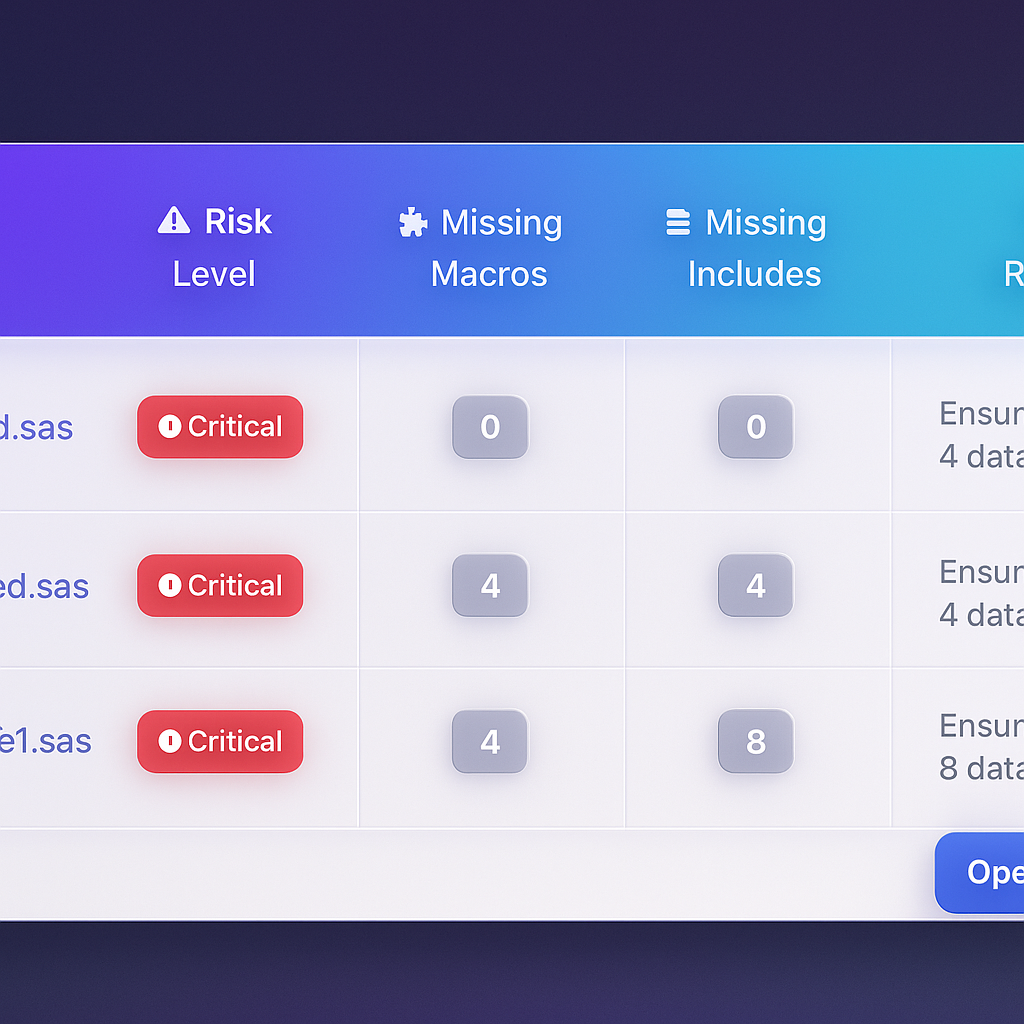
MigryX risk analysis identifies high-complexity programs and recommends optimal migration sequencing
Data-Driven Migration Planning with MigryX
MigryX does not just estimate complexity — it quantifies it. Every program receives a composite score based on lines of code, unique constructs, macro nesting depth, external dependencies, and data volume. Program managers use these scores to build realistic wave plans, allocate resources accurately, and set expectations with stakeholders based on data, not guesswork.
Phase Comparison: The 90-Day Arc
| Dimension | Phase 1 (Days 1–30) | Phase 2 (Days 31–60) | Phase 3 (Days 61–90) |
|---|---|---|---|
| Focus | Discovery & alignment | Convert & validate pilot | Scale & institutionalize |
| Key Deliverable | Estate inventory & pilot charter | Production-validated workload | Wave plan & CoE charter |
| Stakeholders | Sponsor, data eng, business | Data eng, QA, business owner | CTO/CFO, full engineering org |
| Risk Level | Low (no production impact) | Medium (parallel run) | Low (proven approach) |
| Success Metric | Inventory completeness > 95% | Validation pass rate = 100% | 3–5 waves scoped with owners |
| MigryX Role | Automated scanning & scoring | Code conversion & diff reports | Batch conversion & monitoring |
Common Pitfalls to Avoid
Boiling the ocean. Do not attempt to convert your entire SAS estate in one wave. The 90-day plan works because it constrains scope to generate proof points quickly. Enterprises that try to migrate everything at once typically stall after six months with nothing in production.
Skipping validation. Every shortcut in validation erodes trust. If a business analyst discovers a discrepancy that your team did not document, you lose credibility that takes months to rebuild. Invest in automated comparison tooling from Day 1.
Ignoring the people. Technology migration is ultimately a people transformation. SAS analysts who have built careers on the platform need a clear path to upskilling. Pair them with Python-fluent engineers, provide dedicated training time, and celebrate early wins publicly.
Forgetting about orchestration. Converting SAS code to PySpark is only half the story. You also need to migrate the scheduling, dependency management, and alerting that surrounds each workload. Plan for orchestration migration (to Airflow, Databricks Workflows, or Snowflake Tasks) as part of each wave.
Measuring Long-Term ROI
At the end of 90 days, you should be able to project annualized ROI across four categories:
- License cost reduction: SAS licensing typically runs $5,000–$15,000 per seat per year. Each retired seat drops directly to the bottom line.
- Infrastructure efficiency: Cloud-native platforms scale to zero when idle. Compare your current always-on SAS server costs against consumption-based pricing.
- Developer productivity: Modern tooling (version control, CI/CD, collaborative notebooks) accelerates development cycles by 20–40%.
- Time-to-insight: Faster query performance and on-demand scaling reduce the lag between data availability and business decision-making.
The goal of the first 90 days is not to finish the migration. It is to make the case so compelling that stopping becomes unthinkable.
With a structured plan, the right tooling, and disciplined execution, 90 days is enough to transform a migration initiative from a speculative proposal into an funded, board-approved program with measurable momentum.
Why MigryX Is the Foundation of Every Successful Migration
The challenges described throughout this article are exactly what MigryX was built to solve. Here is how MigryX transforms this process:
- Automated discovery: MigryX Compass scans thousands of programs and produces a complete inventory with dependency mapping in hours.
- Complexity scoring: Every asset is scored by code complexity, data volume, and business criticality — enabling precise effort estimation.
- Wave planning: MigryX recommends optimal migration waves based on dependencies, ensuring no pipeline breaks mid-migration.
- 4-8x faster delivery: Enterprises using MigryX consistently report migration timelines compressed from years to months.
MigryX combines precision AST parsing with Merlin AI to deliver 99% accurate, production-ready migration — turning what used to be a multi-year manual effort into a streamlined, validated process. See it in action.
Ready to modernize your legacy code?
See how MigryX automates migration with precision, speed, and trust.
Schedule a Demo