For decades, SAS has been the backbone of enterprise analytics. Banks run risk models in SAS. Insurers calculate reserves in SAS. Government agencies process census data in SAS. But the economics have shifted, the talent pool has changed, and the cloud has rewritten the rules of data infrastructure. Organizations are migrating to Python -- and artificial intelligence is making that migration dramatically faster, more accurate, and less risky than anyone expected even three years ago.
The challenge is staggering in scale. A mid-size enterprise might have 500,000 lines of SAS code accumulated over 15 to 20 years, written by dozens of developers, many of whom have long since left the organization. Manual rewriting at that volume would take years and cost millions. Traditional rule-based translators handle syntax but stumble on semantics. AI is filling the gap -- and it is changing the calculus of what is possible.
Pattern Recognition in Legacy Code
The first breakthrough AI brings to code migration is pattern recognition at scale. Legacy SAS codebases are not random collections of statements. They exhibit recurring patterns: standard data preparation workflows, common statistical procedures, well-worn reporting templates. Machine learning models trained on thousands of SAS programs can identify these patterns and map them to their idiomatic Python equivalents.
Consider the SAS DATA step. It is deceptively simple in syntax but rich in implicit behavior -- automatic looping over observations, the program data vector, retained variables, and output control. A naive translator might produce Python code that technically works but looks nothing like what a Python developer would write. An AI model that has learned from thousands of DATA-step-to-pandas conversions produces code that uses DataFrame.apply(), vectorized operations, and groupby transforms -- the way a skilled Python developer would actually write it.
Pattern recognition also catches higher-order structures. When a SAS program chains a DATA step into PROC SORT into PROC MEANS into another DATA step, the AI recognizes this as an aggregation pipeline and can produce a clean, chained pandas expression rather than four disconnected code blocks.

SAS to Python migration — automated end-to-end by MigryX
Semantic Understanding of Business Logic
Syntax translation is the easy part. The hard part is understanding what the code means -- what business rule it implements, what edge cases it handles, what assumptions it encodes. This is where modern large language models (LLMs) are proving transformative.
LLMs can read a block of SAS code and generate a natural language summary of its business logic: "This macro calculates the 90-day rolling average of claim amounts by policy type, excluding claims flagged as fraudulent, and applies a seasonal adjustment factor from the lookup table." That summary becomes documentation. It also becomes a verification tool -- business stakeholders who cannot read SAS or Python can review the plain-English description and confirm the logic is correct.
More importantly, semantic understanding allows the AI to make intelligent translation decisions. When a SAS program uses PROC LOGISTIC with specific options, the AI does not just map it to sklearn.linear_model.LogisticRegression. It understands which options affect model behavior and selects the correct Python parameters to reproduce identical results, including details like convergence criteria and variable selection methods that a purely syntactic translator would miss.
MigryX: Purpose-Built for Enterprise SAS Migration
MigryX was designed from the ground up for enterprise SAS migration. Its SAS parser understands every construct — DATA steps, PROC SQL, PROC SORT, PROC MEANS, PROC FREQ, PROC TRANSPOSE, macros, formats, informats, hash objects, arrays, ODS output, and even SAS/STAT procedures like PROC REG and PROC LOGISTIC. This is not a generic code translator — it is the most comprehensive SAS migration platform in the industry.
Automated Test Generation
Perhaps the most underappreciated contribution of AI to code migration is automated test generation. Migration without testing is reckless. But writing tests manually for hundreds of thousands of lines of converted code is prohibitively expensive.
AI solves this by generating test cases automatically. Given a SAS program and its Python translation, the AI can:
- Generate synthetic input data that exercises different code paths, including edge cases like missing values, extreme values, and empty datasets.
- Define expected outputs by running the original SAS code against the test data and capturing results.
- Create assertion frameworks that compare SAS and Python outputs with appropriate tolerance for floating-point differences.
- Identify high-risk areas where the translation is most likely to have introduced subtle differences, and generate additional test coverage for those areas.
This automated testing pipeline is what transforms migration from a leap of faith into an engineering process with measurable confidence levels. Organizations can track conversion accuracy at the program level, the procedure level, and even the individual calculation level.
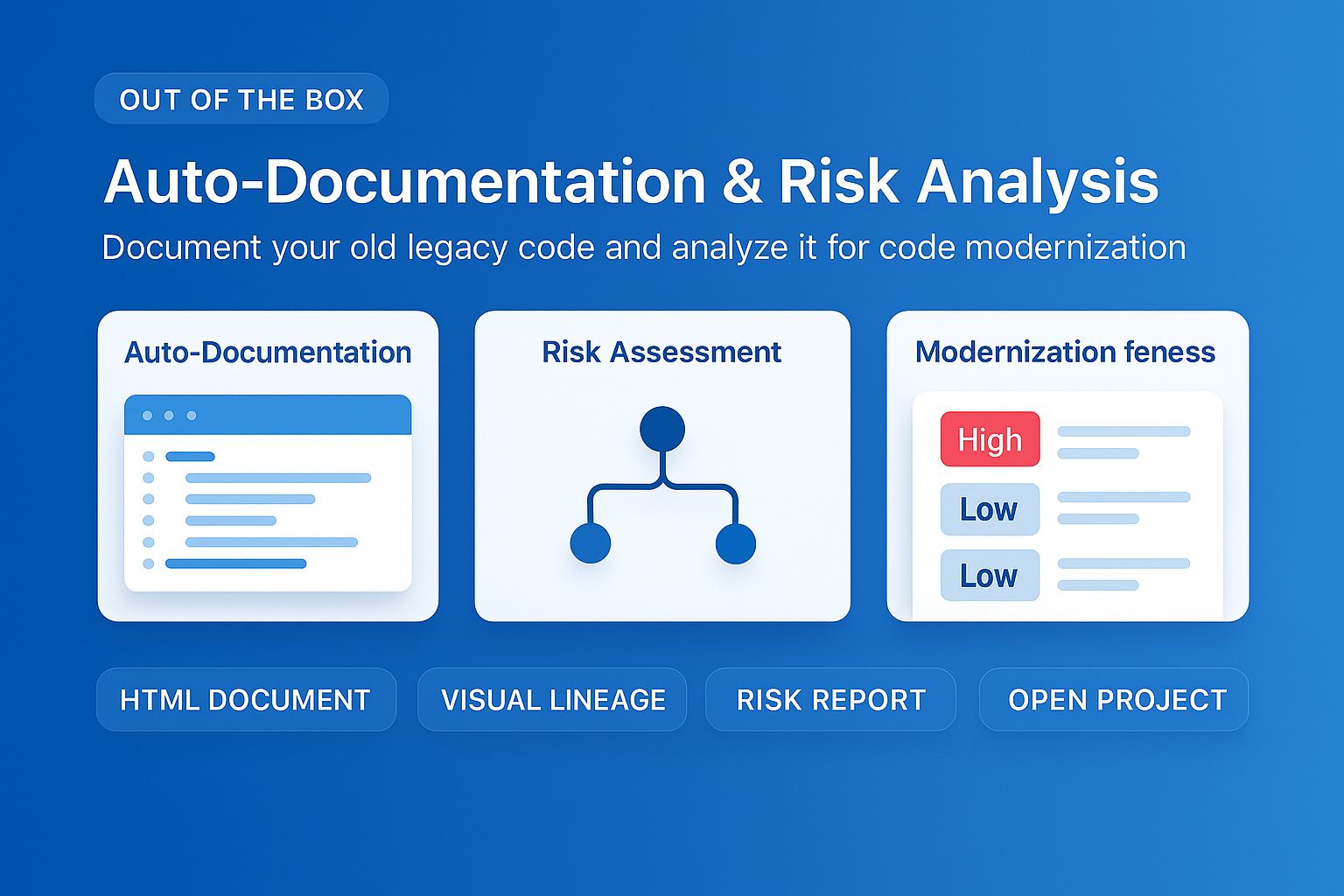
MigryX auto-documentation captures every transformation decision, creating audit-ready migration records automatically
How MigryX Handles the Hard Parts of SAS Migration
Every SAS shop has code that makes migration teams nervous — deeply nested macros that generate dynamic code, DATA step merge logic with complex BY-group processing, hash object lookups, RETAIN statements that carry state across rows, and PROC IML matrix operations. These are exactly the constructs where MigryX excels. Its combination of deterministic AST parsing and Merlin AI means even the most complex SAS patterns are converted accurately.
Natural Language Documentation
Legacy SAS code is notoriously under-documented. Developers wrote it, it worked, and it ran in production for years without anyone needing to understand it deeply. Until now.
AI-powered migration platforms generate comprehensive documentation as a byproduct of translation. Every converted Python module comes with:
- A plain-English description of what the code does and why.
- Input and output specifications with data types and expected ranges.
- Dependency maps showing which upstream datasets feed into each program and which downstream processes consume its output.
- Change logs documenting every translation decision, especially where the Python implementation differs from the SAS original and the rationale for each difference.
The documentation generated during migration is often more valuable than the converted code itself. For the first time, organizations have a complete, readable map of business logic that was previously locked inside opaque SAS programs.
Why Hybrid AI Plus Rules Works Best
Pure AI translation is not the answer. Neither is pure rule-based translation. The most effective migration platforms combine both approaches, and understanding why requires appreciating what each does well and where each falls short.
The Strengths of Each Approach
Rule-based translation excels at deterministic, well-defined mappings. PROC SORT maps to DataFrame.sort_values(). IF-THEN-ELSE maps to np.where(). These translations are 100% predictable and 100% correct. You want rules handling these cases because consistency matters.
AI-based translation excels at ambiguous, context-dependent decisions. When a SAS macro uses dynamic variable names constructed at runtime, when business logic is spread across multiple interconnected programs, when the "right" Python implementation depends on how the code will be used downstream -- these are the situations where AI shines.
The hybrid approach uses rules as the foundation and AI as the intelligence layer. Rules handle the 70% of code that maps cleanly between languages. AI handles the 30% that requires judgment. And critically, AI reviews the rule-based translations too, catching cases where a syntactically correct translation produces semantically different behavior.
Where AI Still Struggles
Intellectual honesty demands acknowledging the limitations. AI-powered migration is not magic, and organizations that treat it as such will be disappointed. Key limitations include:
- Numerical precision. SAS and Python use different floating-point libraries, and AI cannot eliminate rounding differences. It can flag them and quantify them, but some manual review is always required for financial calculations where precision is regulated.
- Proprietary SAS procedures. Some specialized SAS/STAT and SAS/ETS procedures have no direct Python equivalent. AI can approximate the output, but validation against SAS results is essential.
- Implicit institutional knowledge. When a SAS program works around a known data quality issue by silently dropping certain records, the AI might translate the code correctly without understanding the business reason. Human review of flagged edge cases remains critical.
- Performance optimization. AI produces correct Python code, but not always optimal Python code. A separate performance tuning pass -- ideally also AI-assisted -- is needed for production workloads.
The Migration Workflow of the Future
Putting it all together, AI-powered migration follows a workflow that would have been impossible just a few years ago:
- Discovery and analysis. AI scans the entire SAS codebase, builds a dependency graph, identifies dead code, and estimates conversion complexity for each program.
- Automated translation. The hybrid engine converts code in priority order, producing Python with inline documentation and test cases.
- Validation. Automated tests run against both SAS and Python outputs, generating a detailed accuracy report with confidence scores.
- Human review. Data engineers and business analysts review AI-flagged areas -- not the entire codebase, but the specific decision points where human judgment adds value.
- Deployment. Validated Python code is deployed to the target platform (Databricks, Snowflake, AWS, or on-premises) with monitoring in place to catch any production discrepancies.
This workflow reduces migration timelines from years to months. It reduces cost by 60% to 80% compared to manual rewriting. And it produces better-documented, better-tested code than most organizations had in their original SAS environment.
The organizations that move now will benefit from AI that is improving rapidly. The models get better with every migration they assist. The pattern libraries grow. The test generation becomes more sophisticated. Waiting does not reduce risk -- it increases the gap between what your legacy systems can do and what modern platforms offer.
Why Every SAS Migration Needs MigryX
The challenges described throughout this article are exactly what MigryX was built to solve. Here is how MigryX transforms this process:
- Complete SAS coverage: MigryX handles every SAS construct — DATA steps, PROC SQL, macros, formats, hash objects, arrays, ODS, and 20+ PROCs.
- 4-8x faster than manual: What takes consulting teams months of manual conversion, MigryX accomplishes in weeks with higher accuracy.
- 60-85% cost reduction: Enterprises report dramatic cost savings compared to manual migration approaches.
- Production-ready output: MigryX generates clean, idiomatic Python, PySpark, Snowpark, or SQL — not rough drafts that need extensive rework.
MigryX combines precision AST parsing with Merlin AI to deliver 99% accurate, production-ready migration — turning what used to be a multi-year manual effort into a streamlined, validated process. See it in action.
Ready to modernize your legacy code?
See how MigryX automates migration with precision, speed, and trust.
Schedule a Demo